The Best Private and Encrypted Email Providers in 2026
Your inbox is the master key to everything you own online: who can read it matters. A look at the private, end-to-end encrypted email providers worth switching to: Proton Mail, Tuta and Mailbox.org.

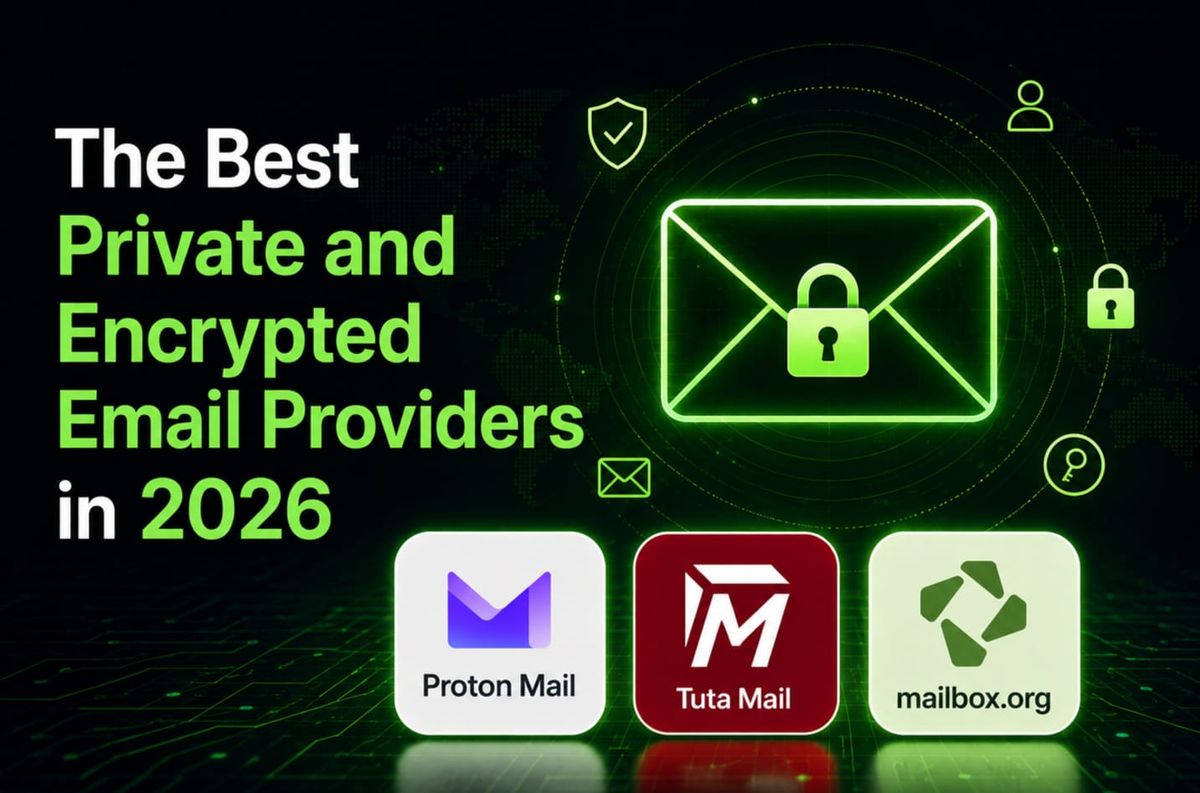
You should think of your inbox as the master key to everything you own online. Every password reset lands there, so whoever can read your email can potentially get into most of your other accounts too.
If you use Gmail, know that Google has access to all of your mails, and increasingly uses their contents to train its AI. Because mainstream providers store your mail in a form they can unlock, your inbox is only ever as safe as their servers, and those get breached constantly. When a provider that can read your email is hacked, your email is exposed too. With truly encrypted providers, a breach hands attackers nothing but scrambled data.
Like every online tool these days, "encrypted" gets thrown around freely, but it means little if the provider can still access your content. This list covers the few options that are genuinely encrypted, where the company can't read what you write or receive.
Proton Mail

Proton Mail is where I'd send almost anyone leaving Gmail. It's a Swiss company, which matters because Switzerland sits outside the EU and US surveillance arrangements and has genuinely strong privacy law. Your stored mail is encrypted so that Proton itself can't read it, and mail between two Proton users is end-to-end encrypted automatically. It comes with a calendar, a decent free tier, and the option to bundle Proton VPN, so if you want one trusted company for several things it fits neatly.
The limits: writing to someone on Gmail or Outlook means that message isn't end-to-end encrypted, because the person on the other end has no key (that's true of everything here, but worth repeating). And to get custom domains and proper storage you'll need to pay, around four euros a month, though the free tier is genuinely usable to start.
Tuta Mail
Tuta (the German provider formerly called Tutanota) is the one for people who want the encryption turned up as high as it goes. Where Proton leaves your subject lines readable for compatibility, Tuta encrypts those too, along with your contacts and calendar, so it shields more of the metadata than almost any other provider. Its apps are fully open source, which means the community can actually check the claims rather than trust them, and you can sign up without handing over a phone number, to stay fully anonymous.
The trade-off is interoperability. Tuta uses its own encryption scheme rather than standard PGP, and it doesn't do plain IMAP or SMTP without its bridge app, so if you rely on Thunderbird or Apple Mail it's a rougher fit. It's also the budget champion here, a usable free tier, or around three euros a month for custom domains and unlimited aliases.
Mailbox.org
Mailbox.org is a good option for the ones who want privacy while keeping the familiar email experience. It's German, runs on renewable energy, and leans on strict EU data law. Unlike Proton and Tuta, it speaks standard IMAP, SMTP and CalDAV, so it drops straight into Thunderbird, Apple Mail or whatever client you already use, and it supports PGP for your stored mail.
The interface is quite dated compared to Proton's, and PGP setup takes a little patience if you've never touched it. But at roughly one euro a month it's the cheapest serious option here.
A word on self-hosting
You'll see people online insist the only truly private email is one you run yourself, on your own server. And they’re not wrong in theory: nobody else touches your data, and you set every rule. But in practice, running your own mail server is a real commitment. You need to be the one handling security, backups, and the endless fight to stop the big tech providers from dumping your mail in spam. For a rare few it's the right call, but for almost everyone one of the providers above will get you the vast majority of the benefits with none of the maintenance.
Which private email to go for?
- Leaving Gmail and want the easy, trusted default: Proton Mail.
- Maximum encryption, including metadata, on a budget: Tuta Mail.
- Private email that still works in Thunderbird and Apple Mail: Mailbox.org.
Simply leaving Gmail or Outlook is already a large privacy win! Every option here keeps your inbox out of the advertising machine, the business model where your emails are scanned to profile you and target ads.
Little reminder: encryption is only half the job! Remember to use a unique strong password, turn on two-factor, be wary of logging in over public Wi-Fi, and consider per-service aliases so the address you hand out isn't the one your whole life is tied to.
FAQ
Is Gmail private or encrypted?
Not in the way people assume. Gmail encrypts your mail in transit and on Google's servers, but Google holds the keys, so it can read your messages, tie them to everything else it knows about you, and use them to train Gemini AI. It isn't end-to-end encrypted, which is the only kind that stops the provider itself from reading your mail.
Which email providers actually can't read my email?
Proton Mail and Tuta store your mailbox so that the company genuinely can't read it, Tuta even encrypts the whole mailbox, including subject lines. Mailbox.org protects your mail with PGP and strong EU data law, though the strongest guarantees come from the zero-access model Proton and Tuta use. Gmail, Outlook, and most mainstream providers can read everything.
What's the most private email provider in 2026?
For most people, Proton Mail: strong zero-access encryption, Swiss jurisdiction, and the easiest switch from Gmail. If you want the encryption turned up higher, Tuta also encrypts your subject lines and metadata. And if you'd rather keep using a standard mail client, Mailbox.org supports IMAP and SMTP natively.